
COMING SOON
Coming soon: whole-body MRI cancer screening at ARIS
ഉടൻ വരുന്നു — ഹോൾ ബോഡി MRI കാൻസർ സ്ക്രീനിംഗ്
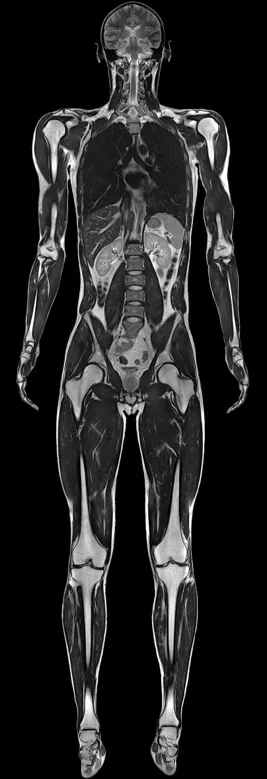
Whole-body MRI is one of the fastest-growing trends in preventive health. ARIS Diagnostic Centre is preparing to offer it at our Kollam centre - a single, radiation-free scan that looks at the body from head to toe.
What is whole-body MRI?
A whole-body MRI takes detailed pictures of the inside of the body in one session, instead of one area at a time. It uses a strong magnet and radio waves, not X-rays, so there is no ionising radiation - which is why it can be repeated safely for follow-up. With modern scanners and sequences such as diffusion-weighted imaging, a screening study can be done in one visit.
Why is it used for cancer?
Whole-body MRI is already an established tool in cancer care: international guidelines use it for multiple myeloma, prostate cancer and melanoma, and for regular surveillance of people with inherited cancer-risk conditions such as Li-Fraumeni syndrome, where yearly whole-body MRI is part of the standard of care. In these high-risk groups, studies show it can help find cancers early, before symptoms.
Can it help healthy people?
More and more people without symptoms are choosing whole-body MRI as a broad health check. Research in this group is still growing: in a review of more than 6,000 screening scans in people without symptoms, about 1 in 100 had a cancer confirmed. Experts point out that the benefit for an average-risk person is not yet proven, and that a scan often shows harmless "incidental" findings that may need a further test. That is why at ARIS every whole-body study will be reported by a qualified radiologist, with clear advice on what, if anything, needs follow-up.
Who may consider it?
- People with a strong family history of cancer, or a known inherited cancer-risk gene - talk to your doctor first.
- People who want a broad, radiation-free health check and understand that it may show findings that need follow-up.
Whole-body MRI does not replace the screening tests your doctor recommends, such as mammography, Pap smear or colonoscopy. It is not suitable for people with a pacemaker or other fixed metal implants that are not MRI-safe.
What will the visit be like?
You change into a gown, lie on the scanner table and keep still while the images are taken; you can listen to music. Most screening protocols need no injection. A qualified radiologist reports the whole study. You receive printed films, plus your images and report on WhatsApp and email (a CD on request).
Your images stay available
As with every ARIS scan, your images are kept for 1 year, so a future scan can be compared with this one - which is where whole-body MRI is most useful: seeing what has changed.
Be the first to know
We will announce the start date and price here and on WhatsApp.
Sources
- Cancer Imaging (2020): review of 12 studies, 6,214 whole-body MRI scans, 1.1% confirmed cancer
- American Cancer Society: Full-Body MRIs: What Are the Risks?
- Memorial Sloan Kettering: Should You Consider a Whole-Body MRI Scan?
- Evaluation of whole-body MRI in Li-Fraumeni syndrome, J Med Genet (2025)
- Ohio State Wexner Medical Center: Full-body MRI
This article is general information, not medical advice. Please consult your doctor.
All articles